Why Love Matters by Gerhardt Sue
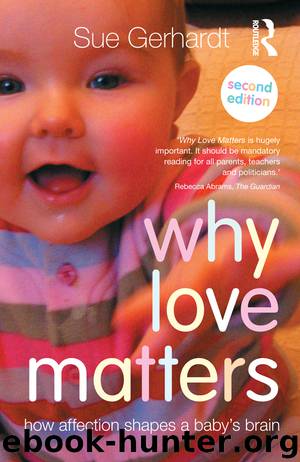
Author:Gerhardt, Sue
Language: eng
Format: epub
ISBN: 9781317635796
Publisher: Taylor and Francis
Post-traumatic stress disorder
The normal response to these kinds of traumatic experience is to be afraid. When this happens, an individual’s amygdala will initiate a fight or flight response and kick various systems into action. The sympathetic nervous system will release adrenaline, and the heart rate and blood pressure will go up. The hypothalamus will then set off a chain reaction which results in the production of cortisol. All these effects normally die down and go back to normal within a few hours. But when the trauma is very extreme or very chronic, this might not happen. It can take as long as a year to recover from post-traumatic stress.
However, the label of post-traumatic stress disorder (PTSD) has become a recognised diagnosis of an abnormal reaction to trauma – one which goes on beyond the normal recovery period. When terrible things happen to people, psychiatrists accept that they will have difficulty in integrating the experience into their normal sense of self. The most common symptoms are intrusive thoughts of the trauma, distressing dreams, insomnia, irritability, anxiety, self-harm and a struggle to avoid talking about the trauma (Green 2003). Sufferers may experience flashbacks, panic or depression. They relive the experience over and over, vulnerable to reminders of the experience and hypervigilant and watchful for signs that something bad will happen again. But a person with normal emotional resources will have a chance to make some sense of it, or at least to draw comfort from others, and eventually find a way to live with it and resume a normal life to a large extent. As with any bereavement, the pain becomes more manageable and intermittent as time goes on. Most people recover their equilibrium within a year or so, but PTSD is the diagnosis for people who don’t recover.
The reason that around 8 per cent (Russo et al. 2012) have a pathological reaction to adult trauma takes us back to babyhood. Many of the people who find it hard to recover from traumatic experience are those whose emotional systems are less robustly built in early childhood. Epigenetics has made it clear that early adversity can alter the function of the genes responsible for stress reactivity (Weaver 2007) and these altered genes can lead to a greater vulnerability to trauma and a predisposition to PTSD in adulthood (Seckl 2008; Seckl and Meaney 2006; Yehuda and LeDoux 2007).
Inevitably, people who have had difficulties in their past emotional lives, will be more likely to interpret current situations in a negative light. They are more likely to have an oversensitive response to stress, but also to interpret events more negatively. Their stress response may be more easily triggered into overdrive when they unconsciously assess a situation as threatening or unmanageable. Obviously, these assessments do play a very important part in the reaction to stressors. When we assess a situation as not very dangerous, the stress response is not going to be triggered. For example, one woman described by Bessel van der Kolk managed to cope very well with being raped, until many months after the event.
Download
This site does not store any files on its server. We only index and link to content provided by other sites. Please contact the content providers to delete copyright contents if any and email us, we'll remove relevant links or contents immediately.
Rewire Your Anxious Brain by Catherine M. Pittman(18658)
Talking to Strangers by Malcolm Gladwell(13376)
The Art of Thinking Clearly by Rolf Dobelli(10492)
Mindhunter: Inside the FBI's Elite Serial Crime Unit by John E. Douglas & Mark Olshaker(9347)
Becoming Supernatural by Dr. Joe Dispenza(8225)
Change Your Questions, Change Your Life by Marilee Adams(7788)
Nudge - Improving Decisions about Health, Wealth, and Happiness by Thaler Sunstein(7712)
The Road Less Traveled by M. Scott Peck(7606)
The Lost Art of Listening by Michael P. Nichols(7508)
Mastermind: How to Think Like Sherlock Holmes by Maria Konnikova(7353)
Enlightenment Now: The Case for Reason, Science, Humanism, and Progress by Steven Pinker(7316)
Win Bigly by Scott Adams(7203)
The Way of Zen by Alan W. Watts(6621)
Daring Greatly by Brene Brown(6520)
Big Magic: Creative Living Beyond Fear by Elizabeth Gilbert(5780)
Grit by Angela Duckworth(5623)
Ego Is the Enemy by Ryan Holiday(5455)
Men In Love by Nancy Friday(5250)
The Laws of Human Nature by Robert Greene(5214)
